November 2025
See how we supported you this last month. The Library is here to support you to embed evidence into clinical practice and support the mobilisation of knowledge.

See how we supported you this last month. The Library is here to support you to embed evidence into clinical practice and support the mobilisation of knowledge.
We are pleased to announce that the Lancashire Health Hub was awarded the Silver Prize at the LIHNN Service Developments Awards last week. The Library team works in part of collaboration between the Lancashire Council and 4 other local NHS Trusts to educate professionals around health/digital literacy and ensure the public have a ‘one stop’ shop for reliable health related information. If you haven’t taken a look, please visit: Lancashire Health Hub | Health Information Lancashire. Our simply aim is to help the people of Lancashire find trusted health information with ease.

The latest Suicide Prevention and Self Harm bulletin from Mersey Care Evidence and Library Service can now be viewed at https://www.evidentlybetter.org/bulletins/suicide-prevention/
This webpage features key links and emerging reports about suicide prevention.
In this issue:
Office for Health Improvement and Disparities (OHID); 2025.
Information and other resources to support commissioners, service providers and others providing alcohol and drug interventions. ‘Co-occurring mental health and substance use: delivery framework’ also added.
Alcohol and drug misuse prevention, treatment and recovery guidance – GOV.UK
Take a look at some of the literature searches we completed last month. The outcomes help to support clinical decision making, inform patient care or plan for service developments.

If you would like to request a literature search, please complete the form below and send it back to academic.library@lscft.nhs.uk
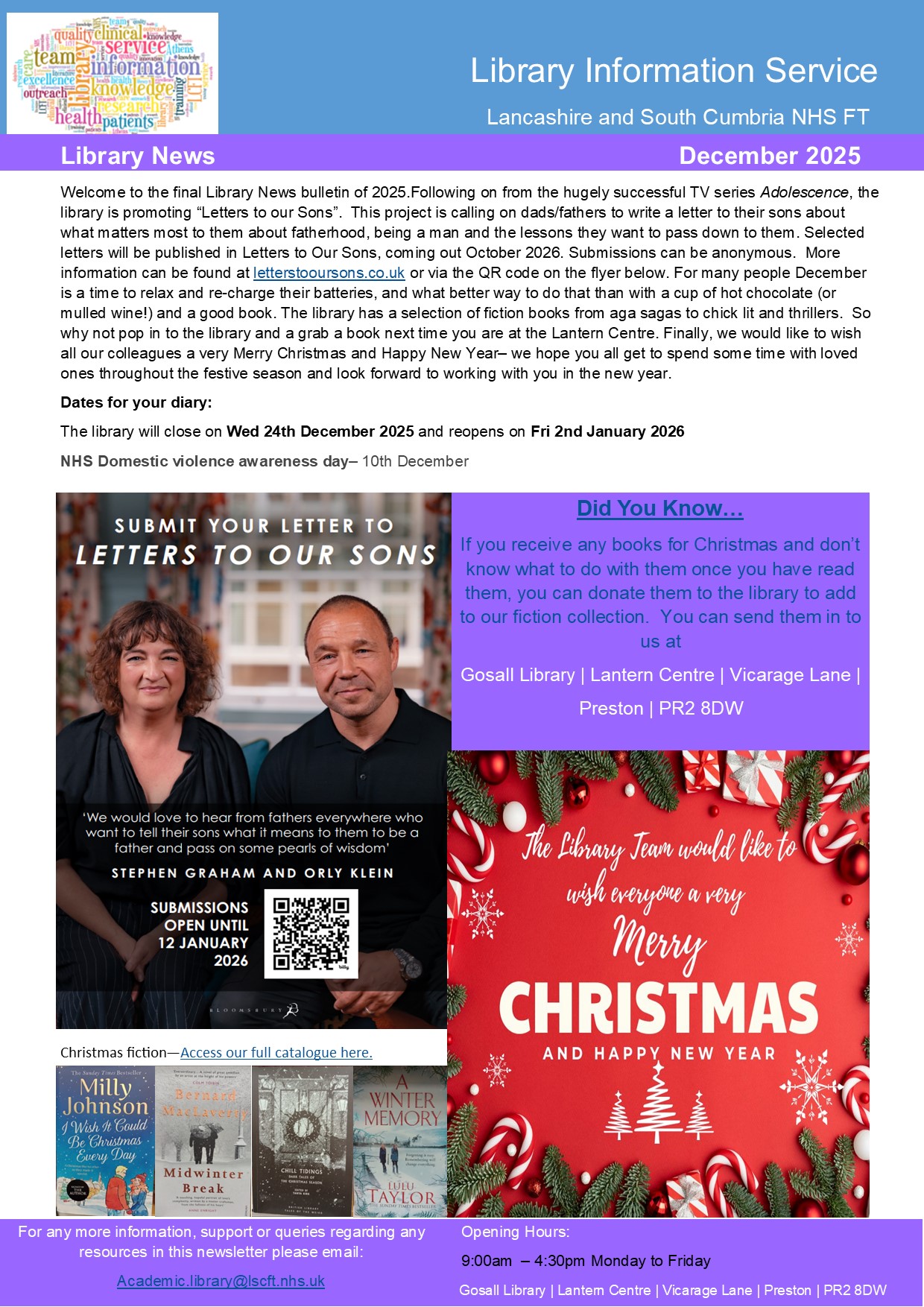
Please take a look at our December Library newsletter. This month we are encouraging all fathers to ‘Submit a letter to our sons’ writing about what matters most about fatherhood and lessons you want to pass down. This is supported by Stephen Graham and Orly Klein – who worked on the TV series Adolescence and hope to increase the communication between fathers and sons.
As always we hope you enjoy reading our newsletter and aim to keep you up to date with current news and awareness.

The Institute of Alcohol Studies has published a new vision for tackling alcohol harm across the country. Created by a wide group of experts in policy, research and treatment, the document sets out a clear and hopeful path for long term progress.
The vision looks at how the UK can create safer communities, strengthen prevention, improve treatment pathways, and reduce the serious health impacts linked to alcohol use. It brings together evidence, lived experience and practical recommendations that can help guide national and local action in the years ahead.
For anyone working in public health, mental health, community safety or addiction services, the report offers valuable insight into the changes that could support a healthier and more resilient future.
Read more: IAS-Long-term-vision-for-alcohol-harm.pdf
The latest Children and Young People’s Mental Health Newsletter is now available to view or download. Some articles are freely accessible, others require an Open Athens account. Please get in touch for support with this: academic.library@lscft.nhs.uk.
The latest Eating Disorders bulletin is now avaialble to view and download. Some articles are freely accessible however others may require an Open Athens account. If you are having issues accessing the articles, please get in touch with the library team: academic.library@lscft.nhs.uk
A new briefing from NHS Providers brings together practical examples of how trusts are strengthening and supporting their research workforce. The resource highlights real world approaches that organisations have used to build research into everyday workforce planning, create opportunities for staff, and embed a culture of enquiry and innovation.
For teams interested in growing their research activity, the briefing offers clear and replicable ideas that can help services develop staff skills, improve evidence based practice, and support better outcomes for patients and communities.